
It usually starts from the street. You pull into the driveway and the roof appears older than the rest of the house. Dark streaks have crept down the north slope. A line that used to be crisp has gone a little wavy. Even when everything else about the house is kept the way you like it. The roof has fallen behind.
Most people give the roof no thought until it forces them to, and by they are rushing to find a residential roofing company. It is the decking under the shingles, the insulation in the attic, the plaster on the ceiling, and in a West Michigan winter, the wall the water found on its way down. The homeowners who stay ahead of it learn to scan a roof for issues early, while it is still a decision and not a scramble.
A roof almost never fails without warning. It shows you, often a year or two before the first leak, in ways you can spot from the ground. The trick is knowing that a roof rarely dies in the open field of shingles where everyone looks. It dies at the edges, where it meets everything else. Read the signs below with that in mind.
Signs Your Roof Needs to Be Replaced
No single sign settles it. One worn spot can be a repair. Several of these at once is a roof telling you it is at the end of its life.
Your Roof Is Past Its Expected Lifespan
Every roof is on a clock, and the material winds it. Standard 3-tab asphalt shingles are built to last about 20 years. The thicker architectural shingles on most newer homes here are rated closer to 30, though our winters and the freeze-and-thaw that comes with them often pull that back to 20 or 25. Metal runs 40 to 70. Tile and slate, longer than you will own the house.
If yours is near the back of its range, start planning, even if it still looks fine from the street. Age on its own is a reason to watch, but age plus anything else on this list is a reason to replace. A two-decade-old roof shedding granules is not a repair candidate. It is a roof that is done.
Shingles Are Curling or Buckling
Stand at the curb and look across the plane of the roof. Shingles are supposed to lie flat and tight. When the edges lift and cup, or the surface goes wavy, the material has quit doing its job.
Two things cause it, and they work together: age and moisture. Old asphalt loses the flexibility that kept it flat and begins to warp. Trapped moisture from a poorly ventilated attic makes it worse, wrinkling the underlayment and pushing the shingles up from below. Either way, once a shingle stops lying flat, wind drives rain underneath it, and the only thing left between that water and your decking is underlayment that, on a roof this age, is as brittle as the shingles above it. Curling across the whole roof is about as clear a signal as you will get.
Granule Loss
Look in your gutters after a hard rain. If they are filling with what looks like coarse black sand, that sand used to be on your roof. Those granules are the shingle’s sunscreen. They take the UV, add fire and impact resistance, and keep the asphalt from drying out and cracking.
A little loss is normal, especially on a young roof. The signs that matter are gutters that fill after every storm, bald patches you can spot from the ground, and shingles that look smooth and shiny instead of textured. Once the granules go in patches, the rest goes faster, because every bare shingle is baking in the sun with nothing left to protect it.
Missing or Cracked Shingles Across Multiple Areas
A few shingles torn off one corner after a blow off the lake is usually a clean repair. Cracks and gaps showing up across several sections of the roof are a different animal. That is not storm damage. That is the material itself failing everywhere at once.
Every crack is a door. Water slips behind the shingle, into the underlayment, down to the decking, and you do not see it until it has worked through the wood and into the attic. Scattered, repeated loss is a sign of the roof going all at the same time.
Water Stains Inside, and Leaks That Keep Coming Back
Most people see the inside before the outside. A ring on the ceiling, a stain creeping down a wall, a musty smell in a closet. By the time water shows up indoors, it has been moving through the roof for a while.
One stain can sometimes be traced to a single flashing detail and fixed. Take it seriously when a leak you already paid to patch keeps returning, or when stains show up in more than one room. That pattern means spot repairs will not hold anymore.
This is also where Michigan earns its reputation. The icicles hanging off your eaves are not just charming. They are usually an ice dam, and an ice dam is a ventilation problem before it is a roofing problem. Heat leaking into the attic melts the snow up high, the water runs down and refreezes at the cold edge, and the pool trapped behind that ice gets drawn back up under the shingles. Shingles were never built to hold back standing water. Which raises a question worth asking: if the trouble starts at the attic and the edge, who is looking there?
A Sagging Roofline or Soft Spots
This one is never cosmetic. Sight down the ridge and the slopes; they should run straight. A line that dips, waves, or feels soft underfoot is a structural warning, not a surface one.
A sag almost always means the decking or the framing beneath the shingles has been compromised, usually by moisture that sat in the wood long enough to rot it. Wet plywood or OSB softens, comes apart in layers, and loses the strength to hold the load above it. Let it reach the rafters and a single rotted one will pull a visible dip into your roofline. A sagging roof is not project to wait on; it’s a this-week priority.
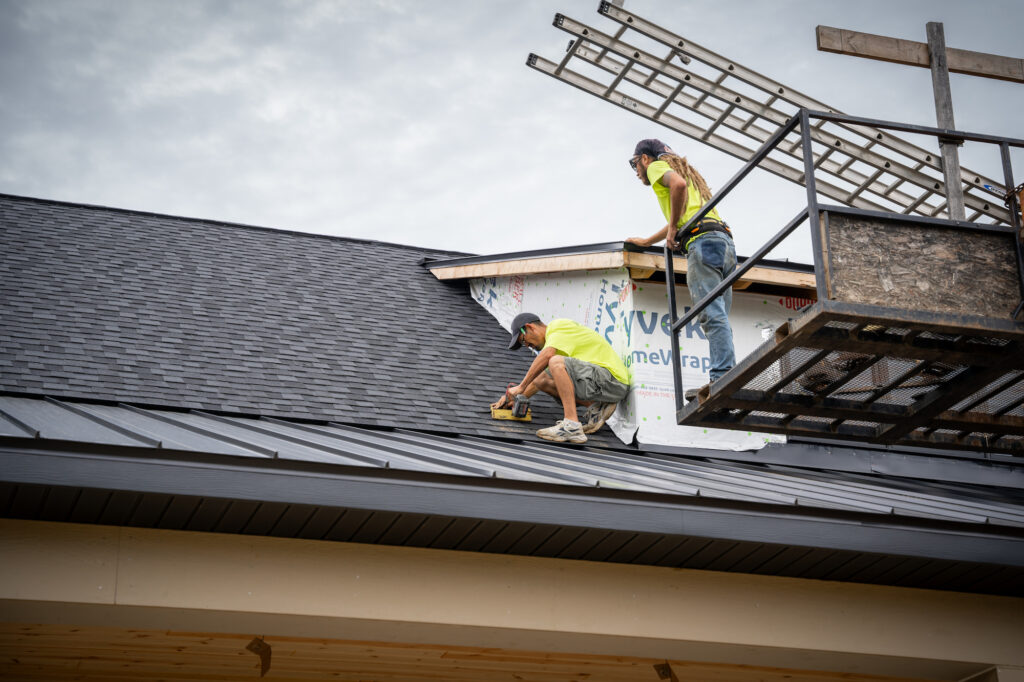
What to Do When You Notice These Signs
The rule is simple. One sign means watch it and get a professional eye on it. Several together almost always mean it is time to replace.
The reason not to sit on it is that a failing roof does not fail politely. The longer it goes, the more the damage moves out of the shingles you can swap and into the things you cannot easily reach: the decking, the insulation, the framing, the ceilings, and the walls when winter ice backs up at the eaves. A roof replacement quietly becomes a roof replacement plus everything the water touched.
So get it inspected. An inspection tells you honestly whether you are looking at a repair or a replacement, and it does that by reading the whole system, not by counting bad shingles. Here is the question to carry into every estimate you collect: who warranties the connection between your roof and your walls? Most roofers stop at the shingles, because shingles are all they do. The roof fails where it ends, and that is exactly the part a quick look from a ladder skips.
FAQ
What are the signs that a roof needs to be replaced? A roof at or past its rated age, shingles curling or buckling, granules collecting in the gutters, cracked or missing shingles across several areas, water stains or repeat leaks inside, and any sag or soft spot in the roofline. One sign earns a closer look. Several at once is a replacement.
How do I know if my roof needs to be replaced or just repaired? Damage in one spot, fresh from a storm, is often repairable. Damage across the whole roof, or a leak that keeps coming back after a patch, is not. The question is whether the problem sits in one place or everywhere, and a proper inspection answers it.
At what age should a roof be replaced? It depends on the material. Plan on about 20 years for standard asphalt, 20 to 30 for architectural shingles, with the low end common in hard winter climates like ours. Metal lasts 40 to 70 years, tile and slate longer. Once a roof is near the end of its range, age plus any other sign means replace.
Can a roof with multiple problems just be repaired? Rarely for long. When several issues show up together, they are usually the same breakdown surfacing in different places. Fix one and the rest keeps aging at the same rate, so you pay again and again for patches that do not hold.
What happens if I wait too long to replace my roof? The damage moves from the cheap parts to the expensive ones. Water gets from the shingles into the decking, insulation, framing, and ceilings, and in winter it backs up as ice and reaches the walls. Waiting turns one project into several.
J&S Siding Roof Replacement
When we climb up to inspect your roof, we are not only looking at your roof. We do siding and windows too, so we read the whole exterior at once: how the roof ties into the wall, where water is most likely to get in, and whether the smart move is the roof alone or a plan that protects the house as one system. A roof is only as good as where it ends, and those connections are the first thing a siding crew notices and the last thing a roofing-only crew thinks about.
We have been on West Michigan roofs and walls since 1999, and our crew leaders average more than ten years with us. That is the difference between a home exterior contractor that stacks parts on a roof and one that installs a roof as a system, built for the winters this part of the state delivers.
If you are seeing any of the signs above, the next step costs you nothing.